By Alex Fogleman
Reviews of:
I’m not sure if it’s just me, but I sometimes think that “my field,” patristic studies, is always at the verge of extinction, quietly drowning amid a sea of louder, more pressing issues. I’m not sure why I would expect otherwise: Who has time to read strange theologians from thousands of years ago when AI and TikTok are destroying the economy and our children’s well-being? If the church fathers are going to be relevant, we’ll have to make them relevant by finding out what they have to say about contemporary topics like gender, sex, politics, and technology.
But when sweet Providence bids me to look up from my self-inflicted despair, I see that, in fact, early Christianity—and particularly early Christian theology—is alive and well. I’m not only encouraged by new book series like Baylor Press’s Studies in Patristic Theology and Spirituality but also the publication of new trade press volumes that offer serious introductions to early Christian theology.
Recently, Eerdmans Press has published two major works by leading patristic theologians in the United States—Warren Smith and Brian Daley. These two volumes not only demonstrate the health and vitality of patristic studies today but also provide students an incisive introduction to the writings of early Christian theologians. They draw us into the conversation and allow us to get to know these patristic voices on their own terms.
Warren Smith is Professor of Historical Theology at Duke Divinity School, and has written top-tier works on Gregory of Nyssa’s ascetical theology, Ambrose’s moral virtue, and the Christian rendering of “magnanimity” in Ambrose and Augustine. He’s also a beloved teacher known for his deep kindness and high standards for his students.
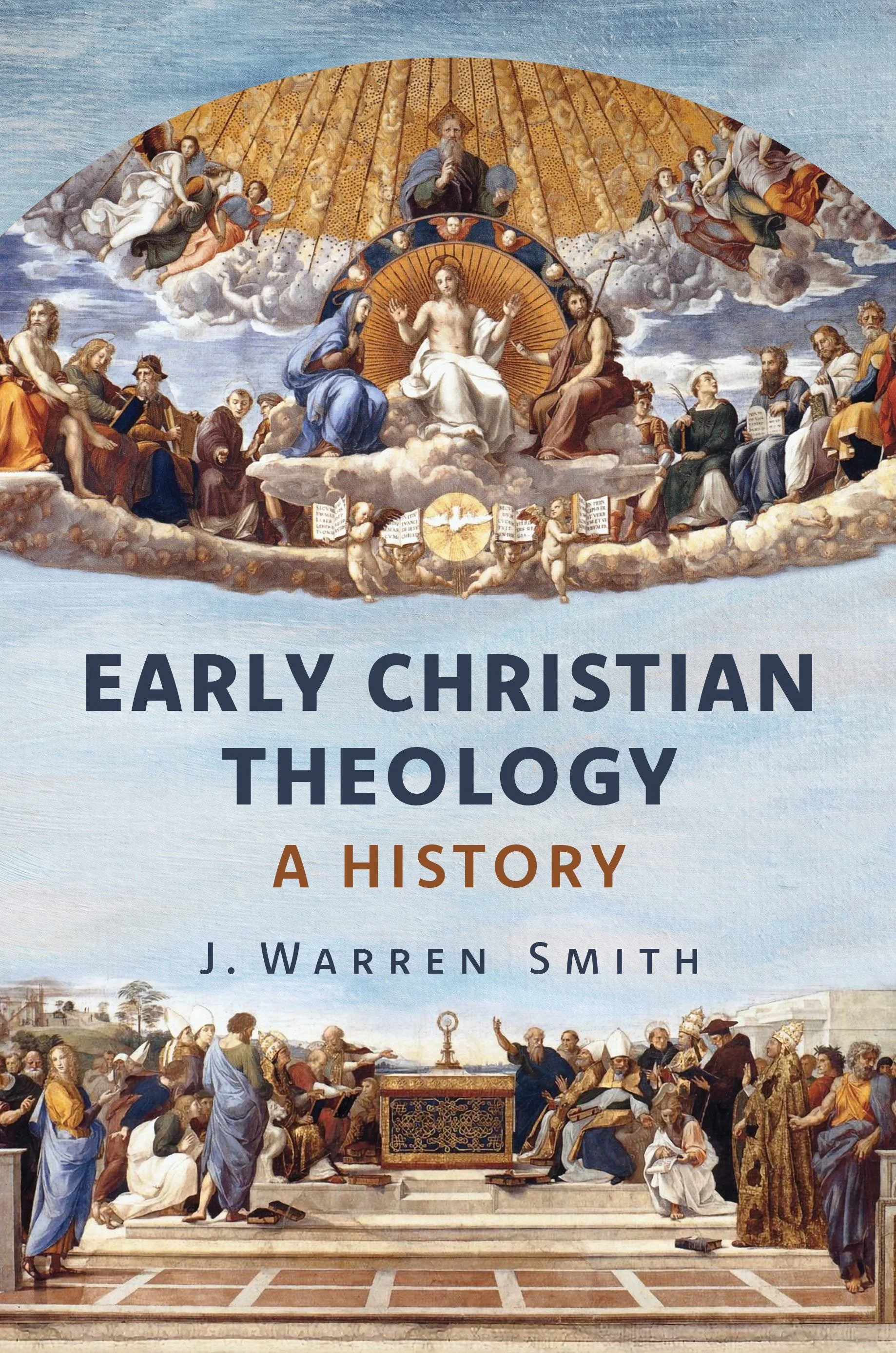
This latest book, Early Christian Theology: A History, is a historical overview of early Christian theology. A much-needed volume, as there has not been anything like a reliable history of patristic theology in many decades, probably since J.N.D. Kelly’s Early Christian Doctrine. Smith is well-aware of the social historical questions about power and complexity and diversity, but he does not allow that to distract from the simple question of understanding how theologians think, read Scripture, and live as members of the church.
Smith covers a wide range of figures, both familiar and unfamiliar, giving students a reliable guide to the key theological debates—Nicaea, Chalcedon and so forth—but also some lesser known questions and controversies and engaging figures that go beyond the typical voices.
It’s a big book, but it is both comprehensive in scope and also tightly focused on helping students encounter the voices and especially the biblical exegesis of early Christian theologians. Each chapter, meanwhile, has helpful links to secondary sources and so forth. An excellent volume both for students as well as pastors or teachers who want a reliable guide for understanding early Christian theology.
A very different kind of contribution is the two-volume set of collected essays from the esteemed patristics scholar Brian Daley. Whereas Smith’s book gives an overview of early Christian theology, Daley’s essays provide focused expositions on a wide range of figures in early Christianity. Also like Smith, Daley is a beloved teacher and mentor, having taught at Notre Dame for many years.
The two volumes, edited by one of his students, Andrew Hofer, are divided into essays on biblical interpretation and essays on Christology—both major focus points of Daley’s scholarship.
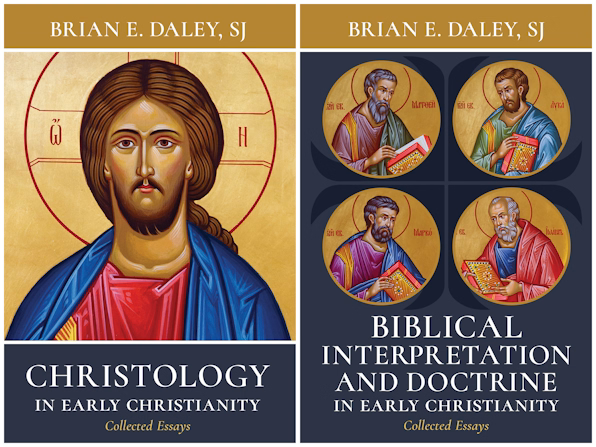
The eighteen essays in the biblical studies collection, Biblical Interpretation and Doctrine in Early Christianity, contain several essays that introduce biblical exegesis, ranging from Origen, to the Cappadocian fathers, to early Byzantine theology, to modern retrievals of patristic exegesis. The essays showcase Daley’s gift of both particular expertise on key issues while also being able to stand back and provide an introduction to the central heart of early Christian exegesis. The essay, “‘In Many and Various Ways’: Toward a Theology of Theological Exegesis” is one of the best introductions to early Christian exegesis I know of.
The sixteen essays in the Christology volume, Christology in Early Christianity, also highlight Daley’s gift of particularity and breadth. He has several essays that provide an excellent introduction to the topic of Christology in the early church, and then several sections on specific touchpoints in christological reflection: especially the Cappadocians’s writing against Apollinarius, Augustine’s understudied Christology, and the subtle and complex debates the developed in Byzantium after Chalcedon. Like the exegesis volume, the provide an exemplary approach to patristic studies. I’ve particularly benefited from the essays on Gregory of Nyssa’s theological writing. Daley is especially good at drawing out the soteriological aspects of the Nyssen’s thought while not reducing Christology to soteriology.
Daley’s essays are not only informative but also exemplary. They let us see a master craftsman at his trade. He helps see the church fathers in new lights, and then helps us look again and see Christ at the heart of Scripture.
Together, Smith’s textbook on early Christian theology and Daley’s two-volume collected essays are a wonderful edition to the study of early Christianity. I wonder, though, about how students will find the institutional contexts to support this kind of study of patristics. There are fewer places where one can do doctoral studies, at least in the United States. Smith is still active in supervising doctoral students at Duke, but I imagine he takes maybe one PhD student in patristics every other year (no hard data on that; just speculating). Daley is retired now, though one can still find reliable guides in Patristics at Notre Dame. But where else?
For the most part, doctoral study in “early Christianity” tends more towards social history or contemporary theology (or more likely, ethics). There are a some isolated pockets—as well as recent creative ventures like the Alexandrian Institute—attempting to meet this need. Or one can go overseas to the UK or Australia. But on the whole, it is harder to find the institutional contexts to support the deep study of early Christian theology.
With publications like, perhaps a new generation will emerge to take up the study of patristic texts neither as ancient relics nor as postmodern theorists in disguise. My not-so-secret hope, too, is that this new renaissance will come not from reviving slumbering academic departments but from the native habitat of theology: namely, the church. It is mostly anecdotal, but more of the young clergy I talk to on a regular basis intuitively “get” the biblical and pastoral sensibilities of an Augustine or Nyssa. They share a common day-to-day world, different as their cultural contexts may be. What they lack, however, are helpful pathways into the thought world of early Christianity. These volumes, I trust, may be just the kind of thing that can spur an ecclesial revival of the study of early Christianity.