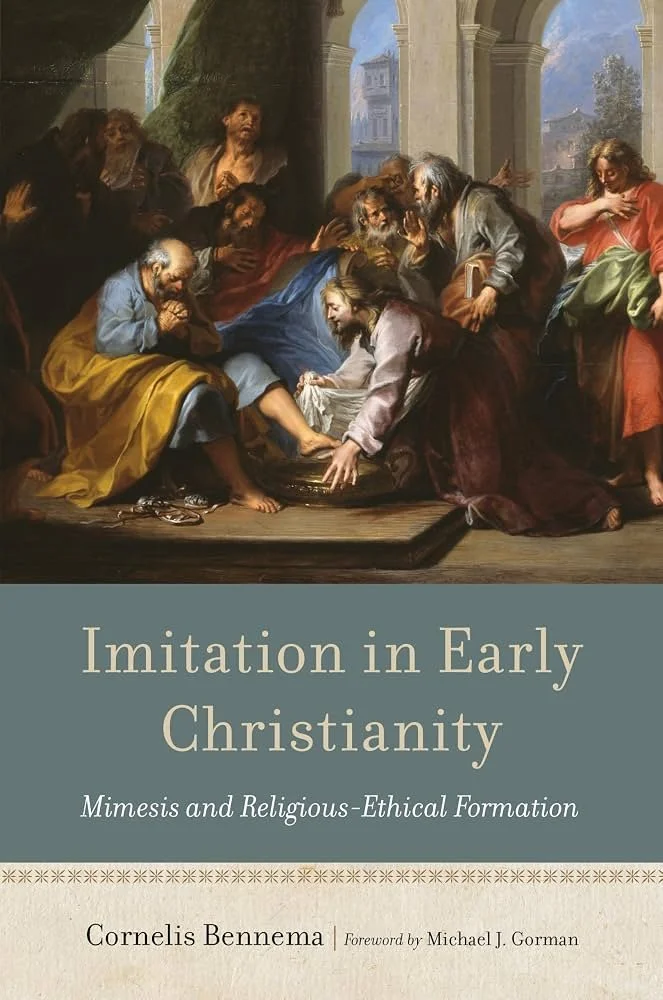
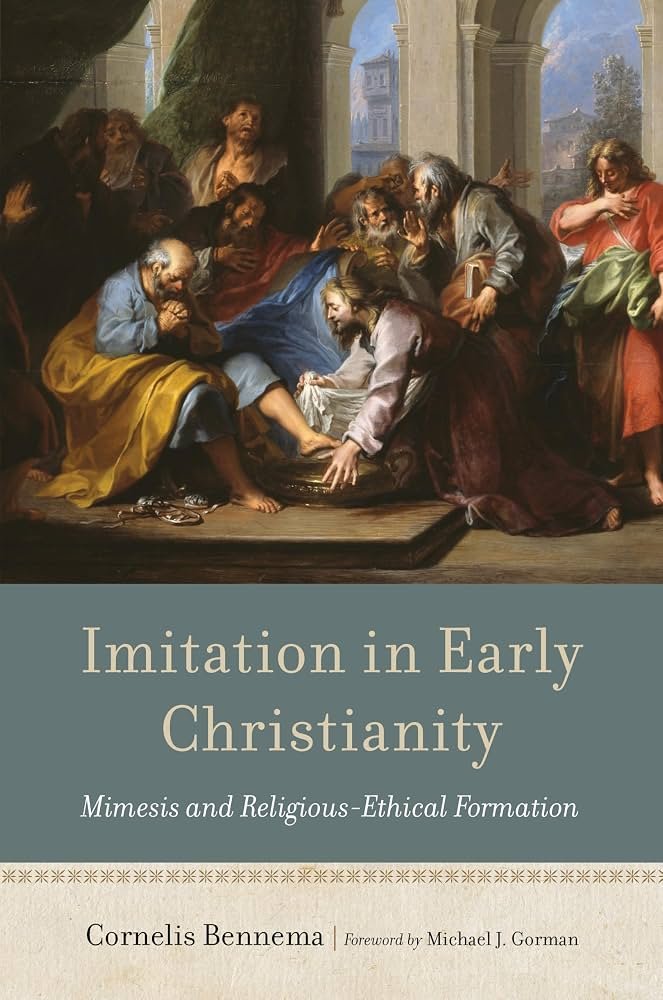
One of the most common critiques of catechetical programs is the fear that catechesis will foster a kind of “rote memorization” approach to spiritual development. Since the core of the Christian faith is a deeply personal relationship with the Triune God, teaching someone about Jesus from a stuffy old book can appear at first glance to stand at odds with such an intimate telos. Thus, the catechist must consider, “How can I both teach proper content and invite my students into a dynamic spiritual life with God?” It is here that Cornelis Bennema’s recent book, Imitation in Early Christianity, can provide us with some insight into what I would consider an “antidote” to these didactic fears: mimesis.
Bennema identifies unifying themes within the diversity of early Christian descriptions of mimesis. He forms a working definition for mimesis based on these sources: “Early Christian mimesis was a dynamic, participatory, creative, and cognitive process within the context of divine family education with the goal for Christians to represent and resemble Christ in character and conduct” (24). This “creative” aspect features prominently for Bennema as one of the defining characteristics of mimesis, differentiating it from mere “cloning” or copying behavior. He uses examples from Greco-Roman descriptions of mimesis to show that “successful imitation requires the student to differ from the teacher’s example enough to show judgment of what to use of the teacher’s example to suit a specific situation” (45). Thus, true imitation requires a kind of internalization of the actions of the teacher, leader, parent, etc., which can be not only replicated but also used as a basis for autonomous moral improvisation. Bennema shows, therefore, that one of the most important parts of the mimetic process is the creative reinterpretation of the teacher’s actions for a contemporary context.
When it comes to the texts of the Christian Scriptures, Bennema finds varied use of mimetic language. In particular, he sees the Johannine and Pauline corpuses to be filled with examples, though of different kinds. Both writers use what Bennema calls a “mimetic chain,” where the faithful disciple ultimately imitates God, but as God’s character has been mediated through some kind of means. Where John primarily positions his readers to imitate the Jesus he presents in his text (359), Paul more often calls for the reader to imitate his life and actions as he imitates Jesus (349). Both authors see the reader’s imitation to be of Christ, whether as revealed in the text or in the life of the disciple of Christ.
Bennema notes that it is in the writings of the ante-Nicene fathers that mimesis begins to take on explicit martyrological language (323). For example, Ignatius of Antioch writes in such a way as to set himself up as a new Pauline figure (331). In doing so, Ignatius continues this “mimetic chain,” inviting the reader to suffer and to love as he does, while he imitates Paul by doing the same (331). Again, this imitation is rooted in Christ’s love and suffering for the entire world. While other authors include others aspects of mimesis, such as mediating divine goods to the world by means of imitating God (336), martyrdom continued to be the predominant way a Christian could imitate Christ. The self-giving, kenotic love of Jesus stood as the standard by which other Christians measured their moral lives.
Bennema’s work provides a necessary voice for those interested in fostering vibrant cultures of catechesis within the church. He notes that teachings on mimesis were rarely soteriological, but rather for those who were already “in Christ” (15). That is, mimesis was primarily a means of education for those who had already called the church “home,” but were now seeking to discern what the Christian life looked like.
As we look into the history of catechesis, we see that catechumens were regularly paired with “sponsors”: older Christians who could model and teach the Christian life through community and observation. Training in the faith was not merely an impartation of information but a training into a way of life. The catechumen would “catch” as much of the Christian life from their sponsor as they would be taught by their catechist. Bennema’s work proves that, for both the authors of the New Testament and the fathers of the church, imitation was a crucial means of instruction in the faith. Especially as “apprenticeship” language surges within modern discipleship circles, such as in the popular writing of John Mark Comer’s Practicing the Way, mimesis ought to be at the front of every catechist’s mind.
Bennema argues that early Christian sources present the imitation of God to be only possible after one has experienced him personally (370). Therefore, though imitating Christ is bound by the text of the Scriptures in certain respects, true imitation requires a form of intimacy with the God one seeks to mimic. Modern catechists ought to consider how they might invite their students into acts of imitation even as they map out their curriculum and train their teachers. Emphasizing imitation provides opportunities for students to apply learned content to their individual spiritual lives, preventing catechesis from becoming “rote memorization,” and invigorating it with a kind of education that can truly shape the whole person.
Kendall Mayo is an Instructor of Bible and History at Providence Classical Christian Academy in Rogers, Arkansas. He received an M.A. in Religious Studies from Missouri State University and is currently a doctoral student at Trinity Anglican Seminary. He is married to Anna, who serves as Kids Pastor at Christ the King Anglican Church in Springdale, Arkansas.