By Alex Fogleman
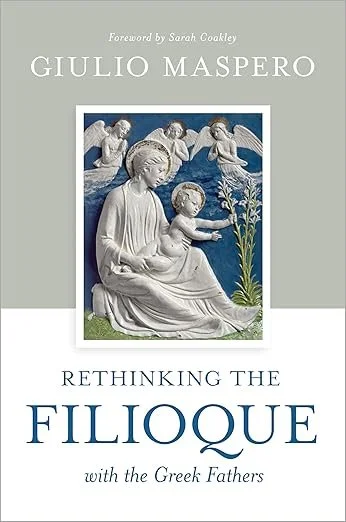
Review of Giulio Maspero, Rethinking the Filioque with the Greek Fathers (Grand Rapids: Eerdmans, 2023)
The filioque is one of the central doctrines that separates eastern and western Christianity. At some point in the late patristic/early medieval period, the phrase “and the Son” (which in Latin is “filioque”) to the affirmation of the Holy Spirit “proceeding” from the Father. So: “I believe in the Holy Spirit, …. who proceeds from the Father and the Son” versus “who proceeds from the Father.”
For many today, it can seem like a strange, trivial notion, arcane to a fault and with little practical relevance. What does it mean? And what’s at stake either way?
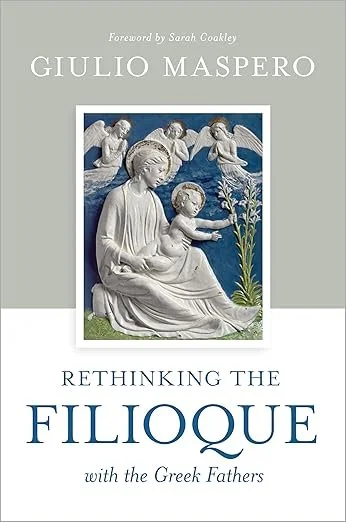
Giulio Maspero is leading patristics scholar, particularly on the writings of Gregory of Nyssa. His 2023 Rethinking the Fliioque is a fascinating historical theological account of the doctrine of the Holy Spirit with lots of ecumenical potential. Writing as a Roman Catholic, for whom the doctrine of the filioque is theologically binding, Maspero undertakes a careful reading of several key patristic theologians in the Greek tradition—especially Gregory of Nyssa—and argues that there is something like a “filioque” in these writers, even though they do not state it in those terms. It’s a careful and adept argument, though it deliberately leaves any contemporary applications undeveloped. Nevertheless, a book like this is crucial for helping overcome historical misunderstandings and offers substantive content for serious dialogue between East and West. At the very least, it’s an important refutation of the common objection that the filioque is a Latin misunderstanding, following Augustine, that is alien to the eastern tradition.
While beginning with with the Apologists, the stage is primarily set in the writings of Origen in the third century, who bequeathed to later tradition two different “models” of Trinitarian thought: a more “linear” model (Father—>Son—>HS) to deflect monarchian modalists’ flattening the divine persons into one “real” divinity; and a more “triangular model” (Father as one source of Son and Spirit; Irenaeus’s “two hands” image). Early fourth-century theologians like Athanasius and Eusebius worked within this paradigm, though primarily thinking about the relation of the Son to the Father, arguing for the doctrine of the homoousios (the Son as of the same substance as the Father).
What becomes hard to fathom is the rise of the Pneumatomachians—the “Spirit-fighters—of the late fourth century who accept the homoousios but not the coequal divinity of the Holy Spirit. This is much more obscure bit of the fourth-century controversy, but it is crucial to understanding this period as a truly Trinitarian theological controversy and not just one about the Son and the Father. In short, he nicely shows the intelligibility of the Spirit-fighting position; in some ways, it is a viable interpretation of the Athanasian homoouison paradigm. But Maspero then shows how figures like Gregory of Nyssa, rejecting their claims, turned to focus on the concept of relation—not just nature—to understand distinction and union in the divine nature. And it is precisely this move to relation (which is another a major focus of Maspero’s theological interests) that spurs the imagining of the Spirit as “between” Father and Son in a way to address and move beyond the challenges of both a strictly linear and strictly triangular pattern.
This brief summary doesn’t do justice to the complex work that Maspero does in this text, with lots of careful exegesis of the key texts. This is admittedly not a good introduction to the topic of the filioque; much of that knowledge is assumed. Moreover, the book is not intended to outline any actionable proposals for ecumenical theology. What this book does really well is help the reader get inside the fourth century writers and understand the key theological, biblical, and ecclesial commitments that are entailed in writing about the Holy Spirit, with an aim to see how reading the texts in this way can provide a new set of categories in which such ecumenical discussions could be fruitful. For that, the book is a marvelous contribution.